Loading…
K8 (Athlon 64)
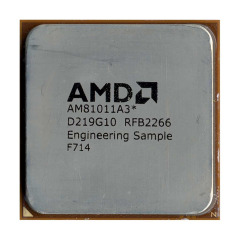
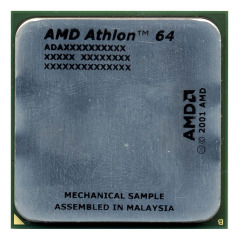
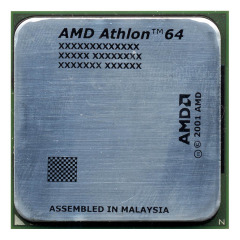
Launched in 2003The original AMD Athlon 64, based on the K8 microarchitecture and introduced in 2003, is a major x86 architectural milestone that extended the K7 design into a 64-bit platform while preserving full backward compatibility with legacy IA-32 software through AMD64, the x86-64 extension that ultimately became the industry standard. Unlike the earlier Athlon XP, K8 integrates the memory controller directly on-die, sharply reducing main-memory latency and eliminating the traditional northbridge-based memory path, while replacing the conventional front-side bus with HyperTransport, a packet-based point-to-point interconnect that improves bandwidth and scalability. Internally, the core remains a superscalar, out-of-order design with register renaming, speculative execution, and a large split L1 cache, but adds a more efficient cache hierarchy, SSE2 support, and a significantly refined branch prediction and load/store subsystem. Early Athlon 64 processors appeared in single-channel Socket 754 and later dual-channel Socket 939 variants, with initial ClawHammer and Newcastle cores built on a 0.13 µm SOI process, and they typically integrated 1 MiB or 512 KiB of L2 cache depending on model. Technically, the original K8 is best understood as the processor that modernized x86 by introducing 64-bit extension, integrated memory control, and HyperTransport in a mainstream desktop CPU, laying the foundation for nearly all later AMD and Intel x86 designs.