Loading…
80186
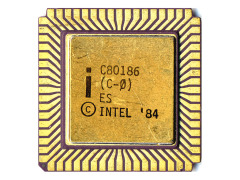
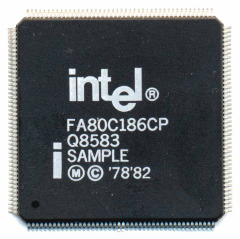
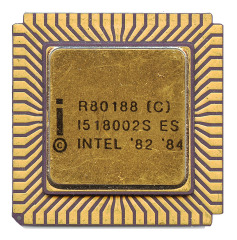
Launched in 1982The Intel 80186 is a second-generation 16-bit x86 microprocessor introduced in 1982 as a highly integrated evolution of the 8086, retaining the same basic IA-16 programming model, 20-bit address space, segmented memory architecture, and 16-bit internal/external datapath while adding substantial on-chip peripheral logic intended to reduce system cost and board complexity in embedded designs. Architecturally it remains software-compatible with the 8086/8088 family but extends the instruction set with useful additions such as ENTER, LEAVE, PUSHA, POPA, BOUND, and immediate forms of IMUL, improving support for high-level languages and structured stack frames. Its main distinction is not radical core redesign but integration: the 80186 incorporates programmable chip-select logic, interrupt controller functions, DMA channels, wait-state generation, and interval timers directly on-die, making it far more self-contained than an 8086-based system built from discrete support chips. This high level of integration made it attractive for controllers, industrial equipment, and embedded computers, but also reduced compatibility with the IBM PC hardware ecosystem, whose architecture depended on separate Intel peripheral components and a different system-level design. As a result, the 80186 became important technically as an embedded x86 derivative rather than as a mainstream PC CPU, occupying a transitional position between the original 8086 and later, more advanced x86 generations.