Loading…
80386
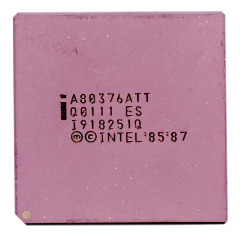
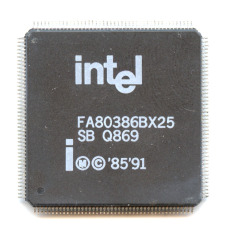
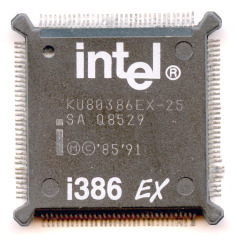
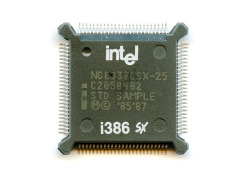
Launched in 1985The Intel 80386 is a 32-bit x86 microprocessor introduced in 1985 that marks the true transition of the architecture from an extended 16-bit design into a full 32-bit computing platform, expanding the programmer-visible register set, ALU, and instruction semantics to 32 bits while extending the physical address space to 4 GiB and preserving backward compatibility with 8086 and 80286 software. Its major architectural advance is the introduction of IA-32 protected mode, with 32-bit general-purpose registers (EAX, EBX, ECX, EDX, ESI, EDI, EBP, ESP), 32-bit offsets, enhanced segmentation, and for the first time a paging unit that enables virtual memory through two-level page translation layered on top of segmentation. The 80386 also introduced virtual 8086 mode, allowing protected multitasking operating systems to run real-mode DOS software in isolated virtual machines, and strengthened the x86 privilege model with more practical support for modern multitasking kernels. Available in both the full 32-bit 386DX and the cost-reduced 386SX variant with a 16-bit external data bus, the 80386 established the fundamental execution model, memory-management architecture, and software environment inherited by later IA-32 processors, making it the first x86 CPU that can be considered fully modern in architectural terms.