Loading…
Pentium Pro
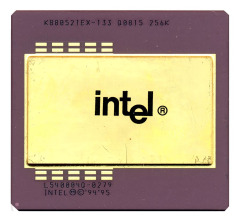
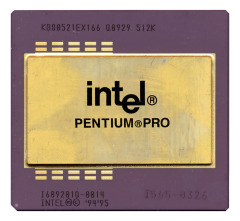
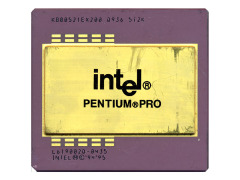
Launched in 1995The Intel Pentium Pro is a sixth-generation x86 microprocessor introduced in 1995 that preserves full IA-32 compatibility while representing a major internal break from the Pentium through the adoption of the P6 microarchitecture, the first Intel x86 core to combine dynamic out-of-order execution, register renaming, speculative execution, and micro-op translation in a deeply decoupled superscalar design. Although externally it remains a 32-bit processor with standard protected mode, paging, and SMP support, internally it translates complex x86 instructions into simpler RISC-like micro-operations that can be reordered and executed by multiple parallel functional units before being retired in program order, greatly improving instruction-level parallelism and sustained throughput. Another defining feature is its advanced cache subsystem, with a full-speed on-package L2 cache integrated in the same module as the CPU die and connected through a dedicated high-bandwidth backside bus, reducing latency compared with motherboard-based cache designs. The Pentium Pro was optimized primarily for 32-bit operating systems and server/workstation workloads, excelling in code that benefits from its aggressive execution engine and large cache, but performing less efficiently in some 16-bit software due to the cost of legacy x86 segmentation and partial-register handling. Architecturally, it established the core execution model later inherited by the Pentium II, Pentium III, and many subsequent Intel processors, making it one of the most important turning points in x86 microarchitectural history.