Loading…
Pentium III
Launched in 1999The Intel Pentium III is a sixth-generation x86 microprocessor introduced in 1999 as an evolution of the Pentium II, retaining the P6 microarchitecture with dynamic out-of-order execution, register renaming, speculative execution, and micro-op translation while adding SSE instructions to improve floating-point, multimedia, and data-parallel performance. It preserves full IA-32 compatibility, MMX support, 32-bit protected mode, paging, and SMP capability, and was produced in several major cores including Katmai, built on a 0.25 µm process and packaged in Slot 1 SECC2 form with external half-speed L2 cache, and Coppermine, built on a 0.18 µm process and available in both Slot 1 and Socket 370 variants, integrating 256 KiB of on-die full-speed L2 cache for much lower latency and better efficiency. Later Tualatin versions shrank the design to 0.13 µm, remained limited to Socket 370 in mainstream form, and further reduced power consumption while increasing clock frequency and cache efficiency. Technically, the Pentium III is best understood as the most mature and highly refined expression of the P6 architecture before Intel’s desktop transition toward the much deeper-pipeline NetBurst generation.
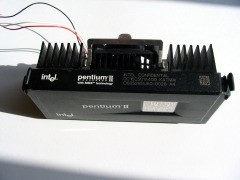 Pentium III 400 MHz ES
6 pictures
Pentium III 400 MHz ES
6 pictures
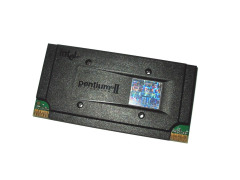 Pentium III 400B MHz ES
4 pictures
Pentium III 400B MHz ES
4 pictures
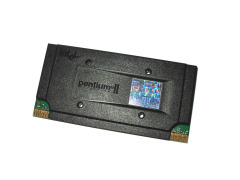 Pentium III 450 MHz ES
4 pictures
Pentium III 450 MHz ES
4 pictures
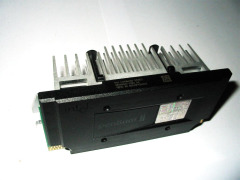 Pentium III 500 MHz ES
7 pictures
Pentium III 500 MHz ES
7 pictures
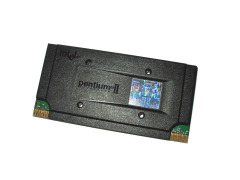 Pentium III 533 MHz ES
4 pictures
Pentium III 533 MHz ES
4 pictures
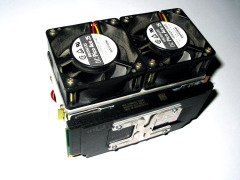 Pentium III 600 MHz ES
6 pictures
Pentium III 600 MHz ES
6 pictures
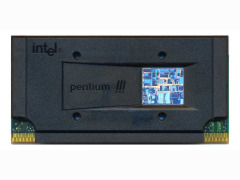 Pentium III 667 MHz ES
7 pictures
Pentium III 667 MHz ES
7 pictures
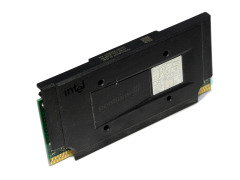 Pentium III 750 MHz ES
4 pictures
Pentium III 750 MHz ES
4 pictures
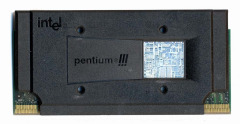 Pentium III 933 MHz ES
6 pictures
Pentium III 933 MHz ES
6 pictures
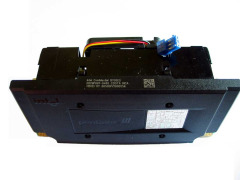 Pentium III 1000 MHz ES
6 pictures
Pentium III 1000 MHz ES
6 pictures
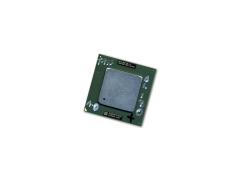 Tualatin 933 MHz ES
3 pictures
Tualatin 933 MHz ES
3 pictures
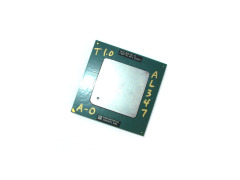 Tualatin 1 GHz ES
3 pictures
Tualatin 1 GHz ES
3 pictures