Loading…
Pentium M
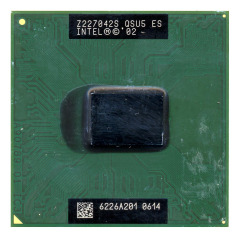
Launched in 2003The Intel Pentium M is a mobile x86 processor introduced in 2003 and based on a highly revised P6-derived microarchitecture rather than NetBurst, designed specifically for notebook computing with a strong emphasis on performance per watt, low latency, and aggressive power management. The first generation, Banias, was manufactured on a 0.13 µm process, used Socket 479 in mobile packaging, and combined dynamic out-of-order execution with a shorter, more efficient pipeline than the Pentium 4-M, along with micro-op fusion, advanced branch prediction, a large 1 MiB on-die L2 cache, and Enhanced SpeedStep support. Its successor, Dothan, shrank the design to 0.09 µm and increased L2 cache to 2 MiB while further improving efficiency and clock scaling. Although it retained full IA-32 compatibility and SSE2 support, the Pentium M was architecturally significant because it abandoned the frequency-first NetBurst approach in favor of a wider, more efficient core whose design philosophy directly influenced Intel’s later Core and Core 2 processors.