Loading…
NexGen
1986-1996Most Notable CPU: Nx586
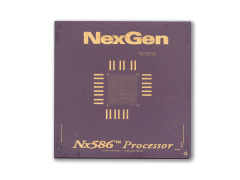
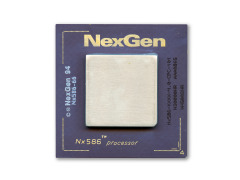
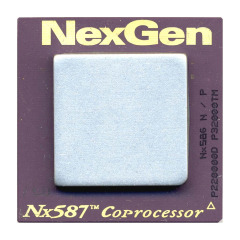
NexGen was founded in 1986 and was one of the most technically ambitious independent x86 CPU startups of the late 1980s and early 1990s. From the start, its goal was not to clone Intel designs at the transistor level, but to build clean-room x86-compatible processors using a very different internal microarchitecture. Its first project, the F86, was conceived as an advanced 80386/80486-class compatible design, but it never became a mainstream commercial product. NexGen’s real breakthrough came with the Nx586 introduced in the mid-1990s. Despite its name, it was not a Pentium clone in the traditional sense, but a highly original superscalar x86 processor with dynamic translation of x86 instructions into internal RISC-like operations. This gave NexGen a strong integer core and competitive performance, but the chip required an external floating-point unit, the Nx587because no integrated FPU was present on the main die. That choice reduced complexity, but it also made the platform less attractive at a time when integrated FP performance was becoming increasingly important.
NexGen later refined the architecture into the Nx686an improved follow-up intended to address some of the Nx586’s weaknesses and move the design closer to a fully competitive next-generation x86 processor. However, the company lacked the financial and industrial resources needed to bring it to market at scale. In 1996, NexGen was acquired by AMD, which was primarily interested in its design team and underlying architectural work. The Nx686 itself never became a commercial AMD-branded CPU, but its technology and engineering talent formed the basis for the K6, which gave AMD a far stronger position in the x86 market. As a result, NexGen disappeared as an independent company, but its historical importance is considerable: it proved that a small fabless firm could produce an original high-performance x86 core, and its architectural approach had a direct legacy in AMD’s post-486 era.