Loading…
C3
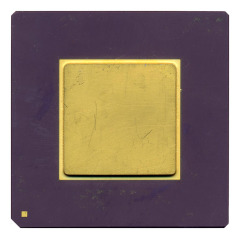
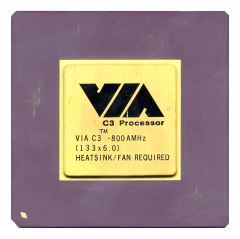
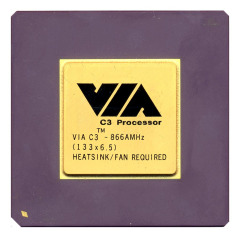
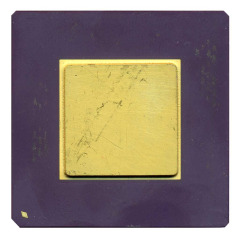
Launched in 2001The VIA C3 is a low-power x86 processor family introduced in 2001 after VIA’s acquisition of Centaur Technology, designed primarily for embedded, compact, and low-cost systems by prioritizing low thermal output, small die size, and minimal power consumption over raw performance. Early C3 models were based on the Samuel and Samuel 2 cores, manufactured on 0.18 µm processes, followed by the Ezra and Ezra-T shrinks on 0.15 µm and 0.13 µm, all using the Socket 370 interface and a relatively simple in-order superscalar microarchitecture derived from Centaur’s WinChip lineage rather than the more aggressive out-of-order designs used by Intel and AMD. Although fully IA-32 compatible and later enhanced with SSE support in addition to MMX and 3DNow!-compatible features in some variants, the C3 remained limited by a weak floating-point unit and modest integer throughput, but it distinguished itself through very low power draw, low voltage operation, and hardware security features such as the later Nehemiah core’s integrated RNG and PadLock-related cryptographic capabilities. Technically, the VIA C3 is best understood as a power-efficient niche x86 design optimized for silent PCs, thin clients, and embedded applications rather than for mainstream desktop performance.