Loading…
VIA
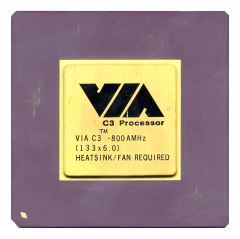
VIA entered the x86 CPU market indirectly rather than as an original processor designer. Its position was built through the acquisition of Cyrix and, more importantly, Centaur Technology, the latter becoming the core of VIA’s CPU effort after 1999. Centaur’s design philosophy was very different from Intel’s and AMD’s: instead of chasing maximum desktop performance, it focused on small die area, low power consumption, and low manufacturing cost, which made VIA processors particularly suited to compact, embedded, and budget systems. Early VIA-branded CPUs such as the Cyrix III and then the VIA C3 were modest x86 processors aimed at low-cost Socket 370 platforms. Architecturally, the C3 family remained relatively simple and power-efficient, with Centaur favoring minimal transistor budgets and practical integration over aggressive out-of-order performance. Later revisions such as Nehemiah added more modern features, including VIA’s PadLock security engine for hardware AES, RNG, and related cryptographic functions, which was unusually forward-looking for such low-power x86 chips.
VIA’s most technically important CPU line was the VIA Nano, launched in 2008 and based on the new Isaiah microarchitecture developed by Centaur after roughly five years of work. Unlike the earlier C3 and C7 families, which were largely in-order and designed around minimal complexity, Isaiah was a substantially more ambitious 64-bit x86 design, with out-of-order execution, stronger floating-point capability, larger caches, x86-64 support, and virtualization support. This made Nano a real architectural step forward rather than a simple evolution of the C7. Even so, VIA remained focused on the same niche: low-power, small-form-factor, and embedded computing rather than direct competition with Intel and AMD in mainstream performance desktops. As a result, VIA CPUs never became major players in the high-volume PC market, but they were historically significant as the continuation of Centaur’s highly pragmatic x86 philosophy and as some of the last commercially relevant non-Intel, non-AMD x86 processors of the 2000s.